How to Flatten Your Whetstones: Why a Level Stone Matters
A level stone changes how your knife feels while you work. Over time a whetstone wears into a slight dish and that alters blade contact. You notice uneven edges, more passes, and unpredictable results.
On this page you will learn why routine maintenance matters and how to keep a flat surface. A flat stone helps maintain a consistent bevel angle and makes each stroke remove metal efficiently.
Think of flattening whetstones as simple upkeep, not an advanced trick. You will check flatness, pick the right tool, and follow a repeatable method: mark the surface, lap evenly with water, and stop when the marks vanish and a straight edge confirms perfectly flat geometry.
Do this before or after sharpening to keep sharpening predictable and reduce frustration when results stall. The steps you’ll follow are short, repeatable, and work for water stones and other stone types.
Why a perfectly flat stone matters for sharper knives and tools
A flat working surface transforms random strokes into steady, efficient sharpening. You will notice the difference the first time: strokes feel even, progress is predictable, and the blade responds the same way across its length.
How a cupped surface throws off your bevel
When the center of your stone cups, the bevel angle shifts as you move along the blade. That changes how much metal you remove at each point and causes an inconsistent edge.
Why water stones need more attention
Water stones sharpen fast because the binder wears away and exposes fresh grit. That speed also makes them lose flatness sooner, so you must check and correct the surface more often.
What productive sharpening feels like
On a true flat surface you feel steady resistance and see uniform scratch patterns. Your strokes track evenly, and it’s easier to keep a straight edge on a chisel or plane blade.
- Measure flatness with a true straight edge—don’t guess.
- If sharpening gets slower or the edge wanders, check the stone surface first.
Flattening whetstones: the right tools and setup for consistent results
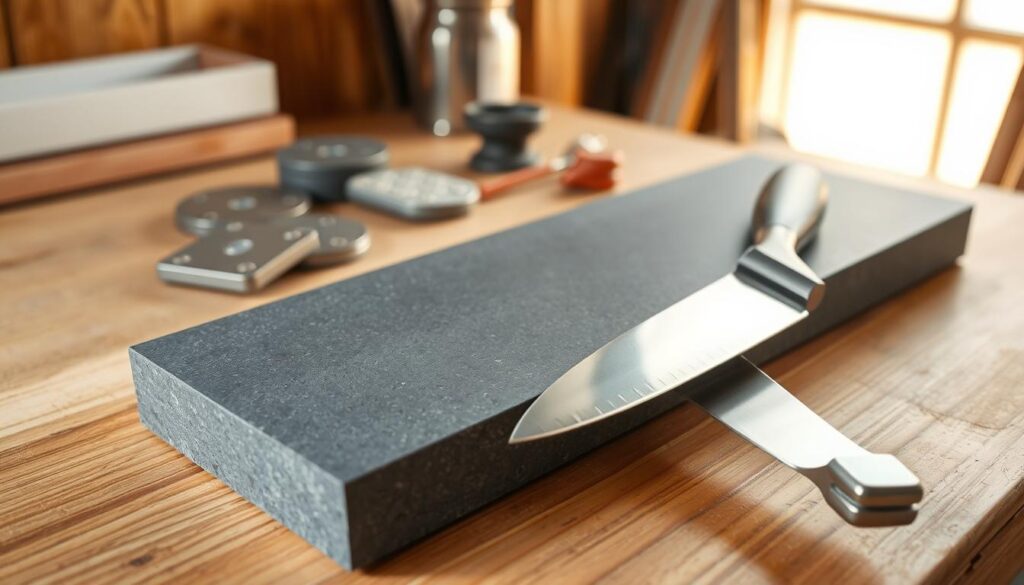
Start with the matching tool, steady base, and plenty of water to get consistent results. Choosing the correct plate or stone saves time and prevents new low spots.
Flattening stone vs. lapping plate
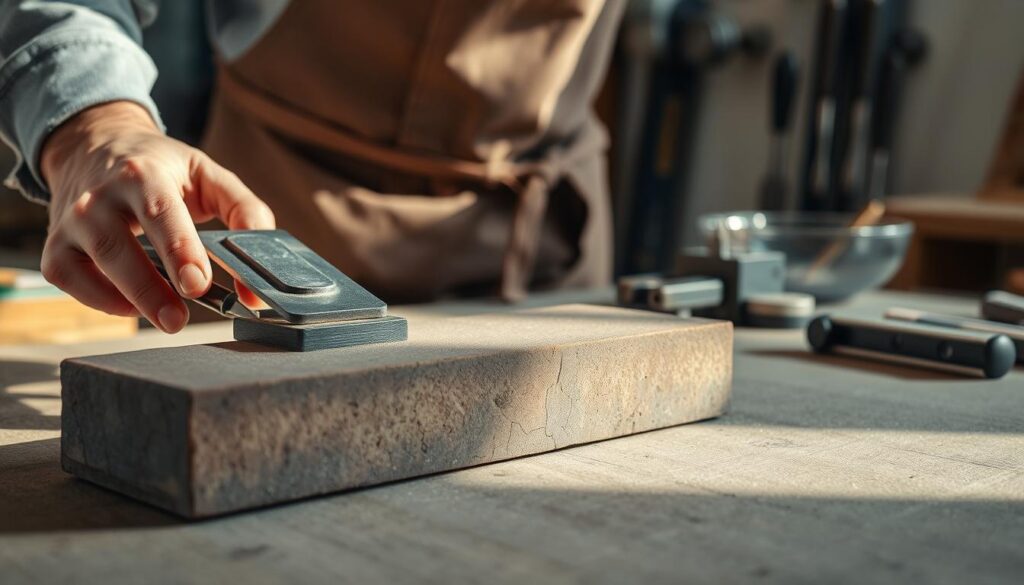
You can use a dedicated flattening stone or a diamond lapping plate. Both deliver even flatness when matched to your stone and grit. A lapping plate, like the DMT Dia-Flat or Dia-Flat 95, cuts fast and holds form for years.
A stone-on-stone tool, such as the Double-Time Flattening Stone, gives gentler, controlled abrasion.
Match grit and manage water
Pair coarse with coarse and fine with fine. Too coarse a tool will leave a fine stone rough. Too fine a plate will slow progress on a coarse stone. This simple rule protects the surface stone and speeds the job.
Use plenty of water so slurry and abrasive material wash away. More water prevents the plate from loading and keeps the cut consistent.
What to have on hand
- pencil for marking the stone
- a stable non-slip base (stone holder or damp towel)
- abundant water or running water to flush slurry
- your chosen plate or flattening stones and basic tools
Make sure your plate, stone, and base are stable. When everything is steady, you avoid rocking and pressure spikes that create new low spots. A brief check for a page blocked extension or blocked extension blocked in your workspace can prevent surprises.
How to tell if your whetstone needs flattening
A quick flatness check tells you whether the stone needs work or is ready for sharpening. Do this before you adjust bevels or chase an edge that won’t behave. Simple tools and a few quick tests reveal whether the surface is true.
Check flatness with a true straight edge and light gap test
Use a quality straight edge, engineer’s square, or combination square across the length and width of the stone. Make sure the straight edge sits flush.
Look for any visible gap. Hold the pair up to light to make small gaps easier to see. If light shows under the edge, the stone needs flattening.
Use the paper-slide method to confirm uneven spots
Place the straight edge on the stone and slip a sheet of paper beneath it. If the paper slides in anywhere, that gap marks a low spot.
This quick paper test confirms what you saw with the light-gap check and helps you map uneven areas on the surface.
Mark the surface with pencil lines to track progress
Draw pencil marks across the stone in a grid or parallel lines. As you lap, the pencil marks show where contact occurs first.
If pencil marks disappear unevenly, the stone needs attention. If marks vanish evenly, your surface is returning to true.
- Tool choice: use a true straight edge, not a flexible ruler.
- Decision rule: visible light gaps, paper entry, or uneven pencil marks mean the stone needs work.
- Tip: try disabling extensions in your workspace if a blocked extension affects your reference tools or workspace notes.
The step-by-step flattening process for water stones and sharpening stones
Follow these clear steps to return your water stones and sharpening stones to a true, usable surface. The method is simple: secure the stone, mark it, lap with plenty of water, and stop when all pencil marks are gone. This keeps your knife edges predictable and reduces wasted work.
Secure the stone and map the surface
Place your whetstone on a non-slip pad, damp towel, or stone stand so it does not move. A steady base helps you apply even pressure during the lapping process.
Use a pencil to draw hash marks in one direction, then again at 90 degrees to create a diamond pattern across the surface stone. These marks show contact points as you lap.
Keep water on the plate and stone
Run tap water or pour freely so slurry and loose abrasive material rinse away. Wetting both the plate and the stone prevents clogging and keeps the cut consistent.
Lap with even pressure and check progress
Move the stone over the plate (or the plate over the stone) using back-and-forth strokes or a random circular motion. Cover the entire surface rather than staying in one spot.
Watch where pencil marks disappear first. If marks vanish at the edges before the center, the middle is still cupped. Continue lapping evenly until all marks are gone.
- Stop periodically to re-wet, inspect, and confirm progress.
- Confirm flatness with a straight edge when hashing marks are removed.
- Rinse and clean both stones to remove slurry and residual abrasive material before you sharpen knives again.
How to maintain flatness and avoid common flattening mistakes
A quick, regular check of your stone keeps sharpening predictable and saves material. Do light maintenance before or after each session so you always start with a true face. This is especially helpful with water stones that wear faster.
Flatten lightly before sharpening if you feel uneven contact. Or do a short pass after sharpening to remove minor ridges. Regular, small adjustments remove less material than rare, aggressive reconditioning.
Common technique errors to avoid
- Uneven pressure — keep steady, moderate force and cover the whole surface to avoid new high or low spots.
- Too little water — refresh water often so slurry flushes away and abrasive cuts consistently.
- Mismatched tools — match coarse stones with coarse flattening tools and fine stones with fine flatteners; a wrong match makes the surface too rough or wastes time.
When to re-check with a straight edge
After you finish using a lapping plate or a flattening stone, re-check with a quality straight edge. If the blade still shows gaps, continue light passes and re-inspect.
Make sure to re-check whenever sharpening results shift unexpectedly. If your workspace shows a page blocked extension or a page blocked alert, try disabling extensions that interfere with reference notes or digital guides.
Conclusion
Keeping your stone true is the single habit that makes every sharpening pass predictable and quick.
Follow a simple process: check flatness, mark with pencil, lap with plenty of water, and stop when the marks vanish. Use a water stone or a plate that matches grit and keep even pressure across the face.
Treat this as routine care. Small, regular attention to your stones saves material and time. When your stone stays flat, sharpening is faster, edges are more consistent, and you end up doing less guesswork on this page blocked or because of a blocked extension.