
The Top 7 Santoku Knives for Precision Slicing and Dicing
You’re shopping for a versatile kitchen tool that speeds routine prep and keeps cuts clean. This roundup focuses on 165–180mm santoku and bunka sizes that excel at vegetables, boneless proteins, and herbs.
Who this serves: home cooks upgrading one do-it-all knife and pros wanting consistent edge feel. The list pairs handmade Japanese blades like Toshihiro Wakui 180mm, Fujimoto Nashiji 165mm, Yu Kurosaki SG2 Fujin 165mm, Nigara SPG STRIX 165mm, and HADO Shiosai Bunka 180mm with Western options from Wüsthof and Mercer.
What “best” means here: a match by steel, maintenance tolerance, handle comfort, balance, and cutting precision — not a single universal winner. You’ll get a quick comparison and short mini-reviews to help you shortlist and confirm fit before you buy.
Note: this guide excludes heavy bone and specialty blades. By the end, you should have a confident pick that suits your board space, grip, and the food you prep most often.
Why a Santoku Knife Belongs in Your Kitchen Right Now
A santoku puts straight, controlled cuts within easy reach for daily meals.
What “three virtues” means for everyday tasks
Slicing, dicing, and mincing are the trio you use most nights. One blade can slice boneless meat and fish cleanly, dice an onion into even pieces, and mince herbs without fighting the edge.
- Slice proteins into thin, consistent pieces for even cooking.
- Dice vegetables with clean faces for uniform texture.
- Mince aromatics quickly without crushing or tearing.
When a santoku beats a chef knife for control and precision
The generally straighter edge and flatter shape favor push cuts and gentle tap chopping. That geometry gives you more control on a crowded board and fewer tool changes during busy prep.
If you favor aggressive rocking or break down large squash, a gyuto or chef knife may still win. But for short-to-medium foods and precise, straight cuts, the santoku shines. Handle comfort and balance matter as much as edge sharpness, so you’ll weigh those in the selection criteria that follow.
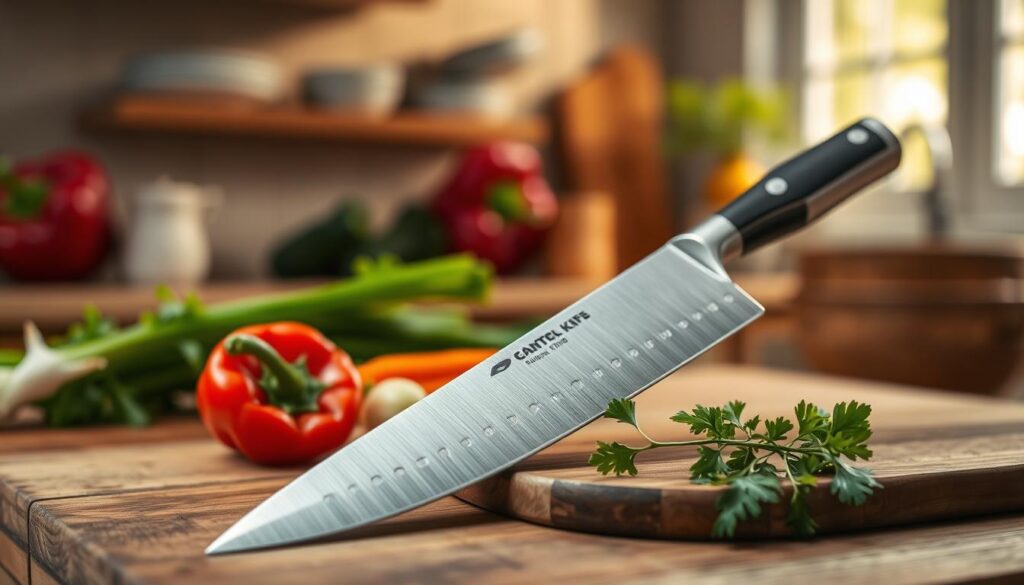
How We Chose These Santoku Knives for 2026
Our selection began with practical tests that reflect how you actually use a knife at home. We combined measurable lab cues with real prep work to judge performance, build, and value across common price bands.
Performance checks you can repeat
- Start of cut: how easily the blade slices paper or a tomato without drag.
- Tracking: whether the blade runs straight through a carrot or veers off line.
- Wedge test: if the edge binds in dense foods, showing poor geometry or balance.
Build and material markers
We note HRC ranges (typical checks at about 57 and 60–61), full tang construction, and handle materials like micarta and pakkawood. Fit and finish must show a consistent grind, a smooth spine and choil, and no hot spots in a pinch grip.
Value and maintenance
Price expectations: under $100 favors practicality; $100–$200 hits the sweet spot for steel, edge retention, and handle comfort; $200+ rewards premium heat treat and finish. Stainless steel is easier for daily maintenance, while carbon cores give a keener edge but need drying and care.
Best Santoku knives 2026: Quick Comparison by Price, Steel, and Best-For Use
This quick comparison lets you match steel, upkeep, and price to how you actually cook. Use the notes below to fast-track a shortlist that fits your prep style and care tolerance.
Best for low-maintenance stainless steel prep
Winners: Nigara SPG STRIX, Kurosaki SG2 Fujin, Wüsthof Grand Prix II.
Choose these if you want easy cleanup, predictable corrosion resistance, and fewer daily chores.
Best for carbon edge lovers who don’t mind upkeep
Winners: Toshihiro Wakui, Fujimoto Nashiji.
Carbon cores give a sharper, more reactive edge. The tradeoff is regular drying and occasional oiling to prevent rust.
Best for home cooks who want a reliable all-around knife
Winner: Fujimoto Nashiji (165mm) and Mercer Genesis as a benchmark.
These balance comfort, price, and everyday performance without exotic maintenance needs.
Best for pros who prioritize precision and consistency
Winner: HADO Shiosai Bunka and Kurosaki SG2 Fujin.
They prioritize fit, finish, and repeatable edge geometry over bargain pricing.
- Price points: $150–$400 cover the most useful range for durability and edge life.
- Compare Western brands (Wüsthof, Mercer) for familiarity when weighing Japanese geometry.
Next, each mini-review will explain why a model earned its label and list concrete specs like length, steel, and handle feel.
Top Santoku Knife Picks for Precision Slicing and Dicing
These select models cover a range of steels and profiles so you can match a knife to how you cook. Below are focused mini-reviews that make comparison quick when you shortlist a new blade for daily prep.
- Range covered: value to premium, carbon cores to powder stainless, and granton-edge options for food release.
- Compare by feel: balance, handle shape, and blade height decide how the knife tracks on your board.
- Maintenance note: carbon cores need more care; stainless and high-hardness steels trade ease for longer edge life.
Toshihiro Wakui Shirogami Stainless Migaki 180mm
Best for: one versatile do-it-all blade with extra height and length. Steel/maintenance: carbon-steel core; must dry and oil. Feel: solid balance, taller profile. Skip if: you want low-maintenance stainless. Price: $281.
Fujimoto Nashiji 165mm by Tadafusa
Best for: value-seeking cooks. Steel/maintenance: nashiji stainless cladding over blue carbon core. Feel: burnt maple oval handle is comfortable. Skip if: you want a premium powder steel. Price: $154.
Yu Kurosaki SG2 Fujin Wa 165mm
Best for: premium stainless performance. Steel/maintenance: SG2 powder steel, longer edge life. Feel: hand-forged balance, precise tip work. Price: $346.
Nigara SPG STRIX 165mm
Best for: high-end, low-maintenance Damascus aesthetic. Steel/maintenance: very hard stainless; easy care. Feel: slightly curvier profile that suits light rocking. Price: $376.
HADO Shiosai Bunka 180mm (blue handle)
Best for: precision slicing and fine tip control. Steel/maintenance: premium finish; very sharp out of the box. Feel: lightweight, tall, thin—excellent for controlled cuts. Price: $407.
Wüsthof Grand Prix II Santoku (7 inches)
Best for: buyers who want a familiar Western handle and easy ownership. Steel/maintenance: reliable stainless steel. Feel: sturdy, comfortable for longer prep sessions.
Mercer Genesis Granton Edge Santoku
Best for: practical, budget-friendly use. Steel/maintenance: stainless with granton edge for food release. Feel: utilitarian; expect less artisanal finish but good value for everyday food work.
Best Santoku for Your Budget: What You Get at Different Price Points
Knowing what each price band delivers helps you match a blade to how you cook and maintain tools. Below is a clear breakdown so you can pick a price range that fits your weekly use and how much time you’ll spend on care.
Under $100: smart starters for your cutting board
Expect safe geometry, decent factory sharpness, and easy care. Edge retention and fit/finish will be basic, but these are great if you cook a few meals per week and want low fuss.
$100–$200: the sweet spot for steel, edge, and handles
This band often gives noticeably better steel and heat treat, plus more comfortable handles and smoother grinds. Fujimoto ($154) is an example that balances quality and upkeep.
$200–$400+: premium fit, finish, and longer-lasting sharpness
Here you pay for powdered stainless or refined carbon cores, thinner grinds, and longer sharpness—Wakui ($281), Kurosaki ($346), and Nigara ($376) show this jump in material and finish.
Collector-tier: when damascus and custom details drive the price
Beyond pure cutting performance you get damascus patterns, limited runs, and custom handles. If you won’t sharpen often, higher edge retention can save you time over years; if you do, a mid-tier knife can be the smarter value.
- Tip: set your budget based on meals per week and how much maintenance you’ll tolerate.
Blade Steel Breakdown: Stainless Steel, Carbon Steel, and Powder Steels
The material under the grind guides how the edge feels, how long it holds, and how you care for it. Read this short guide to match steel choices to your routine and how often you want to sharpen.
Stainless options for low‑maintenance kitchens
Stainless steel like VG-10 or AUS-8 gives corrosion resistance and easier daily care. If you often leave a knife on the board mid-prep, stainless reduces rust risk and fuss.
Carbon cores: why the edge feels “wicked” and what you trade
Carbon steel cores produce a keen, biting edge that many cooks call “wicked.” A carbon core can form a patina as it ages, which can protect the metal but needs regular drying and oiling to avoid rust. Examples include Wakui and Fujimoto, which pair a carbon core with cladding for some protection.
Powdered steels (SG2/R-2): sharpness and longer intervals between sharpening
Powdered stainless steels like SG2 or R-2 hold a keener edge longer, so you spend less time sharpening. They can be harder and more chip-prone, so technique and blade geometry matter. Yu Kurosaki’s SG2 models show how powdered steel boosts edge life with careful grind work.
- Quick takeaway: if you hate maintenance, favor stainless; if you chase peak edge feel, choose carbon; for longer time between sharpenings, consider powdered steel.
Edge, Shape, and Grind: What Actually Changes Your Cutting Results
Small geometry changes in a blade often produce the biggest differences in how your cuts behave.
Granton edge vs smooth edge
Granton edge can help food release when you slice potatoes, cukes, or other wet vegetables. The dimples reduce suction so slices fall away more easily.
It does not replace good technique or a sharp grind. A poor bevel still drags. Mercer Genesis is a clear example where a granton edge aids release but needs a solid grind to shine.
Blade height and belly
Taller blades give you more knuckle clearance and feel more stable for bigger cuts. Flatter profiles favor straight push cuts and tight control.
A curvier belly supports light rocking; Nigara’s slightly curvier shape lets you rock comfortably without losing precision.
Length guidance
Choose 165mm if you want compact control for small produce. Pick 170mm for a balanced middle ground. Move to 180mm when you want more board coverage without switching to a full chef knife.
- Quick selection tip: match length and shape to your board size, hand size, and the food you cut most.
- Key takeaway: geometry drives cutting results more than brand; prioritize profile that fits your motion for better balance and control.
Handle and Balance: How to Pick the Right Feel in Your Hand
How a handle feels can change a long prep session from effortless to tiring. Grip shape and weight distribution affect your balance and control more than blade specs do.
The two common styles are Western and Japanese wa. Western handles are familiar, often heavier, and suit a chef who likes a palm grip. Wa handles are lighter and favor a pinch grip that reduces fatigue during fast, repetitive cuts.
Materials you’ll see:
- pakkawood — water resistant and stable for kitchen use.
- micarta — rugged grip that holds up to wet hands (Black Linen Micarta appears on some Hattori models).
- maple — warm feel; Fujimoto’s burnt maple oval handle shows comfort at a modest price.
Check for a full tang and a modest bolster for durability and predictable balance. Full tang construction shifts weight toward the handle, helping steadier control. A heavy bolster can change the pivot point and feel.
Before you buy online, do simple fit checks mentally: is there pinch grip clearance, will a hotspot form, and does the listed balance point match your style? Wüsthof leans toward Western familiarity, while Japanese makers favor lighter, nimble santoku and santoku knife profiles for precision.
Santoku vs Chef Knife: Which One Should You Use for Your Cooking Style?
Choose your primary blade based on how you move during prep: push, slice, or rock. That motion decides which tool gives you the most precision and control in the kitchen.
Why a straighter edge excels at precise, clean slicing
A santoku favors straight push cuts. The straighter edge keeps thin slices even for herbs, onions, and delicate protein. A santoku knife in the 170–180mm range often delivers cleaner, repeatable cuts with less rocking.
When a chef knife makes more sense for larger food
A chef knife (gyuto) usually ranges from 150–300mm and works well for big tasks. Use it for melons, cabbage, and large roasts where a longer belly and extra length speed up slicing and smooth rocking motions.
- If you prefer straight push cuts, choose a santoku knife for tight, clean precision.
- If you break down large food, a chef knife’s extra length helps.
- Many cooks keep both: a santoku for daily detail work and a chef knife for volume.
If 180mm feels small, make a chef knife your primary and keep a santoku as a secondary tool. Either way, your comfort and cutting style should guide the choice—not tradition.
Care, Sharpening, and Cutting Board Tips to Protect Your Knife’s Edge
Small daily habits protect edge geometry and stretch the time between full sharpenings. Follow a few simple steps and you’ll keep the blade performing at high quality for years.
Daily care for stainless vs carbon steel
Stainless steel: wash with warm water, wipe dry, and store safely. Even stainless benefits from avoiding prolonged moisture and acidic contact.
Carbon steel: wipe during prep, dry immediately after washing, and oil lightly if you won’t use the knife for a while. Patina is normal — rust is not.
Sharpening basics: keep a consistent edge
Maintain a steady angle when you sharpen and touch up the edge before the blade feels truly dull. Use stones or guided systems and avoid pull-through gadgets on hard steels.
Cutting board choices and safe don’ts
- Use wood or soft plastic cutting boards to reduce micro-chipping.
- Do not scrape the board with the edge, twist in hard squash, or cut through bone.
- Tip: carbon-core blades reward disciplined drying; powdered stainless tolerates gentler technique and a forgiving board.
Conclusion
Your next santoku should fit your hands, your habits, and the foods you prep most.
Use this quick recap to finish your choice: Wakui and Fujimoto suit carbon-core fans who accept extra care. Kurosaki and Nigara favor long edge life and low upkeep. HADO serves precision work with a thin profile. For familiar feel and accessible price, consider Wüsthof or Mercer.
Choose steel first, then confirm profile and length, then pick the handle that offers confident balance and control. If you cook often and want low fuss, pick a hard stainless model. If you chase peak edge feel, pick a carbon-core blade and plan maintenance.
Real performance comes from geometry and how the knife fits your hand, not just brand or finish. Pick one, commit to basic care and a good cutting board, and you’ll see immediate gains in slicing, dicing, and chopping around your kitchen.