
How to Safely Tighten or Re-glue a Loose Kitchen Knife Handle
If your kitchen tool wiggles or twists at the grip, it’s a real safety issue. You’ll feel wobble where the grip meets the blade. That movement can cause slips and cuts even when the blade itself looks fine.
Most cutlery is built around a tang that extends into the grip. When the tang is intact and the grip material is sound, a food-safe adhesive or tightening the fasteners can restore stability.
There are two main paths: tighten existing hardware or re-glue with an atoxic epoxy or moldable compound. If the tang is broken or the grip is crumbling, stop and replace the tool—home repair won’t be safe.
Safe means no twist, good alignment, and no gaps that trap moisture. You’ll use common tools and food-safe materials, check fit often, and move slowly.
Next, you’ll walk through safety checks, diagnosis, tools, tightening steps, and epoxy re-glue so you can make a confident, lasting repair.
Safety first before you work on the handle and blade
Start by securing your work area so the repair does not create new danger. Create a flat, padded surface and keep the workspace clear of clutter. Position the tool so the blade cannot twist while you work.
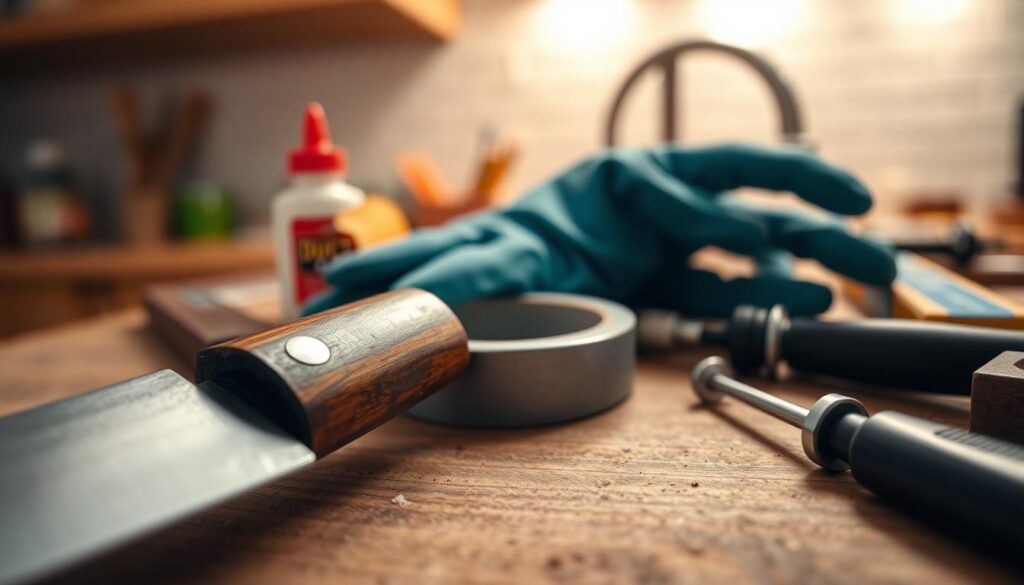
Stabilize the knife and protect your hand
Immobilize the blade on a bench or cutting board. Pad hard surfaces with cloth or rubber to stop sliding. Place the handle so you never have to force the blade or torque it with your hand.
Use basic safety gear
Wear gloves for chemical and edge protection, safety glasses for dust or chips, and a dust mask in tight spaces. These steps reduce exposure when sanding, filing, or mixing epoxy and adhesive.
Know when not to proceed
- Visible tang or shank damage
- Major cracks at the junction between blade and grip
- Handle material that bends under light pressure
Keep kids and pets away, clean sanding dust and squeeze-out right away, and if you doubt the repair, get professional help. A stable part protects your hand and preserves the blade over time.
Diagnose what’s loose and how your knife handle is attached
Begin with a quick construction check so you can target the real cause of wobble. Knowing the tang style tells you which repair will work best.
Identify the tang and scale style
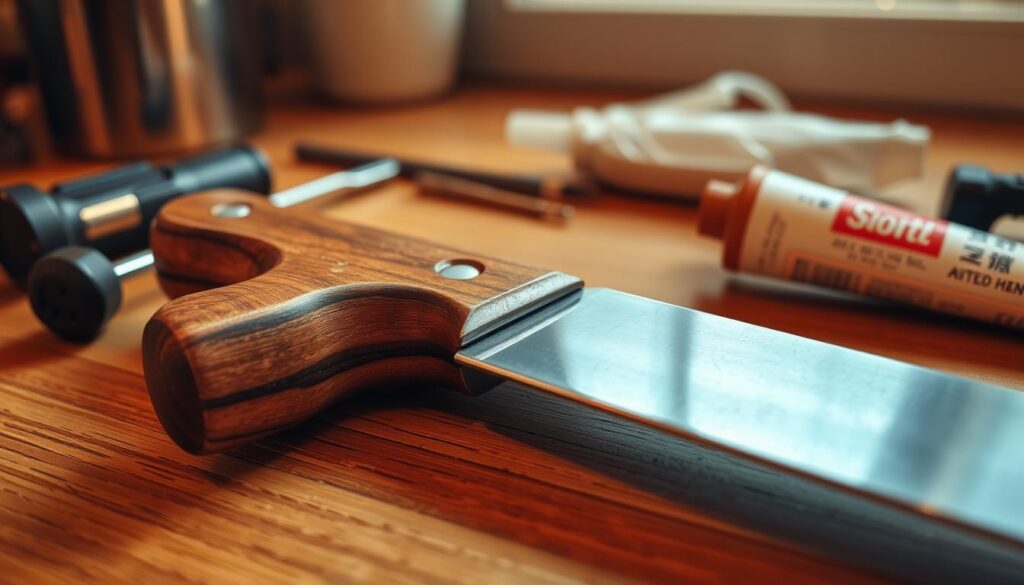
Look for a full tang (visible along the side), a hidden tang (buried inside), or a threaded tang with a nut at the butt. Threaded tangs often show a nut and can be tightened if hardware is intact.
Run a simple movement test
Hold the blade steady and gently twist the grip. Note whether movement happens at the blade-junction, along the scales, or the whole piece turns as one unit.
Inspect for damage and root causes
Use good light and check for hairline cracks, splits, chips, deformation, or corrosion near rivets and bolsters. Corrosion on metal parts often means moisture reached internal channels and weakened the fit.
- Loose scales shift on one side; a tang issue feels like rotation of the whole grip.
- Likely culprits: loosened rivets, missing screws, or an enlarged internal groove.
- If the tang is cracked or the part is structurally failing, stop and seek professional help.
Document what you find with notes or photos so you choose the right tools and materials in the next step.
Tools and materials you’ll need for Fixing a loose knife handle
Prepare a compact toolkit that covers measurement, cleaning, bonding, reinforcement, and finishing. Having the right items on hand saves time and reduces the risk of making the part worse.
Inspection and tightening basics
Essential tools: a properly sized screwdriver, an Allen wrench set, a small pry tool for careful scale separation, and a caliper or ruler to measure hardware and gaps.
Correct sizing matters: the right tool prevents stripped screws, chewed-up slots, and cosmetic damage that complicates later work.
Cleaning and prep supplies
Start with mild soap and water to remove grime, then use isopropyl alcohol to strip oils. Keep lint-free cloths and masking tape to protect the blade and catch any squeeze-out.
Bonding, gap-filling, and reinforcement
Food-safe bonding options: choose a quality epoxy for high-strength, thin-gap bonds and consider moldable adhesive like Sugru to rebuild small shapes around a piece.
For larger cavities use epoxy putty; for shallow gouges try wood filler. Dowels or small splints add reinforcement in cracked wood or synthetic scales.
Sanding and finishing gear
Use sandpaper in a progression from coarse to fine to restore comfort and grip, then finish with a polishing cloth. Match prep and adhesive choice to wood, synthetic, or metal parts so bonds hold rather than peel.
- Safety: gloves, safety glasses, and a dust mask.
- Why this helps: clean surfaces and right tools reduce repeat loosening and save you time.
How to tighten a loose knife handle with screws, rivets, or a tang nut
Begin with the hardware: inspect screws, rivets, and the tang nut before you apply torque.
For screw or bolt-style grips, follow this safe sequence to avoid stripped threads or crushed material.
- Seat the correct bit fully and apply straight downward pressure so the driver won’t cam out.
- Tighten in small increments—turn a quarter to a half turn, then test.
- Stop when snug. Do not force it; over-tightening can split the scale or strip metal threads.
Check your work with a simple test
After each adjustment, stabilize the blade and give the grip a gentle twist. Confirm the part is firm while avoiding torque that stresses the joint.
Dealing with rivets and missing fasteners
If rivets spin or fall out, you usually need replacements, not brute force. Match diameter and length to the original and install new rivets or screws.
- Source parts from woodworking suppliers like Lee Valley or your local hardware store.
- Have the shop size them if the rivet is uncommon for kitchen pieces.
Threaded tang and nut guidance
On threaded tang designs, protect surfaces and use the correct spanner. Grip the nut squarely, tighten slowly, and avoid slipping that can gouge the tang or covers.
Replace fasteners or switch to epoxy?
If hardware bottoms out but wobble persists, the internal channel may be worn. Replace fasteners when fit is solid and only the fastener is bad.
Choose epoxy or moldable adhesive when the cavity is enlarged or movement continues despite proper torque. The goal is durable work, not brute force.
How to re-glue a loose handle with epoxy repair for a secure, food-safe bond
Begin your repair with careful prep: remove old residue and map where gaps need material. Good prep makes the adhesive perform as intended and keeps the work safe for kitchen use.
Disassembly and cleaning
If you can remove scales without damage, take them off. If not, open accessible gaps and protect the blade with masking tape.
Clean well: wash, dry fully, then wipe surfaces with isopropyl alcohol to remove oils and old glue so epoxy will bond to clean material.
Test-fit and gap assessment
Dry-assemble the tang and piece to confirm orientation and find where the fit is loose on each side. Note which side needs added material.
Choose epoxy or putty
- Use liquid epoxy for thin gaps to get full contact and strong bonding.
- Use epoxy putty when the cavity is worn and you must rebuild material around the tang.
Adhesive application and assembly
Spread epoxy on both the tang and inside the cavity so surfaces are wetted. Assemble slowly to control squeeze-out and wipe excess with a cloth.
Clamp, cure, and finish
Clamp firmly but not so tight that you distort wood or synthetic parts. Re-check alignment early in the cure window, then let the epoxy cure the full manufacturer time.
After cure, sand rough edges, restore grip texture, and seal wood with a food-safe finish for moisture protection.
Final checks before use
- Perform a controlled twist test and light pressure test with the blade supported.
- Scan for gaps or squeeze-out that wasn’t removed.
- If all feels secure, return the knife to your drawer and use with normal care.
Conclusion
Finish the job by confirming stability and committing to simple maintenance. First, diagnose construction and the root cause, then choose hardware tightening or bond-based repair so movement stops for good.
If the tang is cracked or the structure is failing, replacing the tool is safer than a home repair. Prioritize safety over saving a worn piece.
Quality makes repairs last: clean surfaces, correct fit, proper cure time, and a final stability test before you prep food.
Quick preventive checklist: wipe dry after use, avoid soaking, skip the dishwasher for sensitive materials, and re-check fasteners and rivets periodically.
If you doubt food-safe materials or the repair still shifts after your best effort, pause and consult a reputable sharpening or knife shop for professional help.