
The Push-Pull Method: Perfecting Your Hand Sharpening Technique
This short guide gives you a repeatable push-pull approach for Hand sharpening techniques on chisels, plane irons, and carving knives without using machines.
You’ll learn what success looks like: an edge that cuts controlled slices, not just one that feels sharp. Practical cues from carvers and woodworkers—burrs, marker checks, and scratch patterns—help you know when to move on.
This method focuses on consistency, speed, and minimal metal removal so sharpening doesn’t steal time from your woodworking. You’ll follow a clear workflow: setup, grit progression, angle control, push-pull strokes, burr management, back work, and finishing.
Expect fast touch-ups and full restores when needed, plus simple checks you can trust. Use the push-pull routine to keep your tools ready and spend more of your shop time making, not fussing with the blade.
Why the Push-Pull Method Works for a Sharper Edge
The push-pull approach gives steadier contact and repeatable wear, so edges cut predictably.
At the bench, “sharp” is easy to verify. You want clean end grain cuts, thin shavings, and slices that need no force.
That kind of performance shows in how a tool tracks and how smooth the wood feels after a pass. A keen edge slices fibers instead of tearing them, so your control improves and tearout drops.
The push-pull motion encourages stable contact and even pressure. Repeating the same strokes creates a uniform wear pattern across the bevel. That consistency is why a simple routine gets results close to machine work.
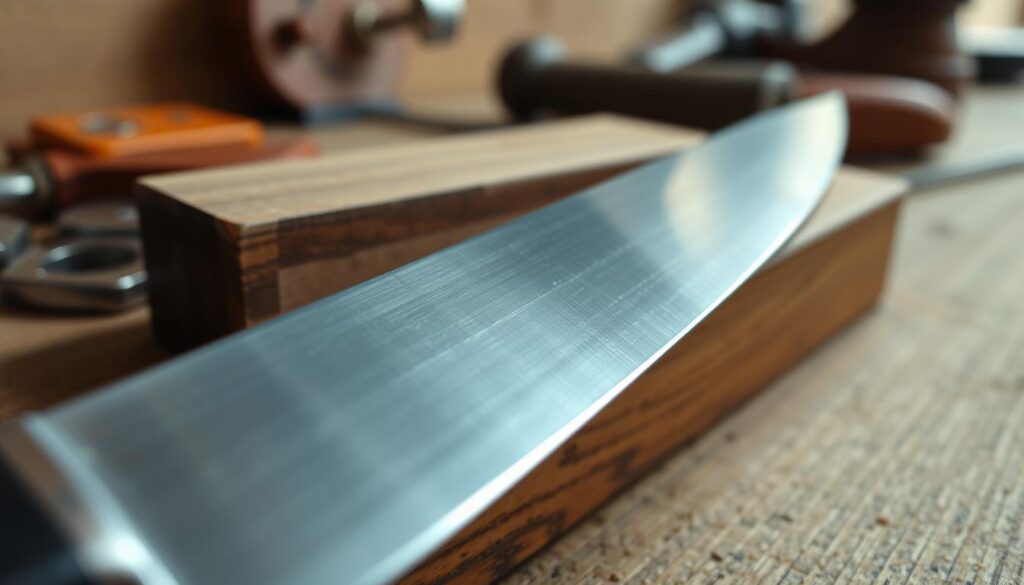
With a modest station and steady hand work, you save shop time while keeping tools ready. Focus on cutting performance rather than a perfect-looking bevel. Efficiency here is not a shortcut—it’s a repeatable process that keeps you cutting more and fussing less.
- Verify sharp: clean end grain cuts and thin shavings
- Control: less force, smoother surfaces
- Repeatability: steady strokes for consistent edges
Hand Sharpening Techniques: The Key Terms You Need to Know
Clear definitions make the process repeatable—know these terms and you’ll read your results faster.
Bevel
The bevel is the angled surface you create on the edge. It determines how the edge bites wood and how long the edge lasts. A fresh bright bevel looks uniform and reflects light evenly.
Burr (wire edge)
A burr is a thin fold of metal that forms when you reach the cutting edge. You can feel it with a fingertip; it signals you can move up a grit. If you leave the burr, the blade will tear fibers instead of slicing cleanly.
Grit, strop, and compound
Grit is the abrasive size that first shapes steel and then refines scratches as you move finer. Use paper or sharpening stones in a progression so scratches tighten predictably.
A strop with compound polishes the edge and removes the last burr for a low-resistance finish. Stropping gives a near-mirror edge that slides through wood.
Dish and glaze
Dish is when a stone hollows from use; flatten it or your bevel angle drifts. Glaze is a loaded surface of metal and spent abrasive that slows cutting. Both feel like the stone stops cutting and scratch patterns stop changing.
- Practical cues: bright bevel, felt burr, tightening scratches.
- Tools covered: knife, chisel, and plane iron adjustments come later.
- Tip: don’t move up grits until the burr runs the full edge.
Set Up Your Sharpening Station for Control and Consistency
A dead-flat base is the fastest path to repeatable edges. Use a 1/4″ glass piece about 6″×12″ as the bed for abrasive paper. Soak the wet/dry silicon carbide paper, lay it on the glass, and smooth bubbles so the abrasive sits flat.
Flat surface and paper backing
Backing the paper on glass makes the abrasive cut faster and more evenly. Add non-skid padding under the glass so it won’t move. Make sure the paper stays wet while you work to prevent clogging.
Positioning to lock your angle
Place the glass or stone so its length is perpendicular to your body. That setup lets you eyeball the angle and keep your hands moving in a straight, repeatable path. A steady station reduces angle drift and cuts down on double bevels.
Lubrication basics
For oil stones use a light oil as manufacturers recommend. Waterstones need soaking (coarse) or light spraying (fine). Ceramic and diamond require no lubricant—clean them with soap and water to remove embedded metal.
- Use a flat glass piece with silicon carbide paper for quick setup.
- Keep the abrasive wet, add non-skid padding, and stabilize the surface.
- Correct positioning and lubrication speed reaching a burr and save time on your hand sharpening work.
Pick the Right Sharpening Stones, Paper, and Grit Progression
A smart grit plan gets you from a damaged bevel to a refined edge without wasted passes. Decide the starting abrasive by the edge condition: coarse for nicks and reshaping, medium for routine maintenance, and fine for polish and low drag.
Coarse to fine: use silicon carbide paper or a coarse stone to shape quickly. Move up through grits so each step removes the scratches from the last. That steady progression protects steel and saves time.
Practical stone comparison
- Diamond: fast cutting, stays flat, no lubrication required; great for hard steel and repair work.
- Water stones: cut well; soak coarse stones, spray fine ones. They need flattening more often but leave a clean finish.
- Oil and ceramic: oil stones work but add mess and possible staining; ceramic is low-maintenance and needs no lubricant.
Keep it simple: owning a medium and a fine stone (or a combo stone) covers most needs. Reserve coarse stones or paper for reshaping or heavy damage. Match your choice to the tool steel and your workflow so the process stays repeatable and efficient.
Dial In Your Bevel Angle and Profile Without Overthinking Degrees
Set a practical bevel and stick with it. Repeatability beats chasing exact degrees. When you hold a steady angle, you waste less steel and reach a keen edge faster.
Use these functional ranges as a rule of thumb: 15°–20° for soft wood like pine or basswood and 25°–35° for harder wood such as oak or walnut. A lower angle slides easier; a higher angle gives strength and durability.
Bevel profiles and tradeoffs
A flat bevel gives the best control and clean entry. A rounded bevel tends to roll and lose working shape. A hollow-ground profile can cut well but may become brittle and dull faster.
Avoiding a double (blunt) bevel
A double bevel appears when your angle wanders and you remove the true edge. That edge can feel sharp but will cut poorly. Keep a steady wrist, use the same setup, and check with a marker or burr test to ensure the whole bevel is hitting the abrasive.
- Consistency: repeat the same angle every session.
- Match angle to wood: shallow for soft, steeper for hard.
- Profile choice: prefer flat for control; avoid hollow shapes for fragile work.
How to Do the Push-Pull Sharpening Strokes Step by Step
Start each session by fixing a reliable contact point so you repeat the same stroke every time. This simple habit saves time and prevents accidental angle drift.
Lock the bevel
Place the top of the bevel down, then rotate the blade until the cutting edge just kisses the stone. This is your repeatable starting position.
Control pressure
Apply firm pressure to cut metal on both push and pull, then ease off slightly as the burr forms. Too much force collapses the angle and rounds the edge.
Stroke mechanics
Use smooth push-pull passes driven by your shoulders and body, not a twitching wrist. Keep the blade tracked straight across the surface.
Tool-specific motion
For gouges and V-tools use side-to-side passes to avoid a scalloped shape. For knives and chisels follow the bevel line with even strokes.
Marker check and quick fixes
Coat the bevel with a marker, take a few strokes, and inspect ink wear. If one area stays dark, shift the stone, shorten the stroke, or lighten pressure.
- Repeat the step until a full-length burr appears.
- Lock wrist and arm position to keep the same angle across sessions.
- Make small mid-session corrections rather than heavy passes.
Chase, Feel, and Manage the Burr So You Know When to Change Grits
Feeling the burr is your clearest progress signal. Use it to avoid guessing when to move to the next grit. A consistent burr tells you the whole bevel has been worked and the edge is ready for the next step.
How to check the wire edge safely
Lightly slide your fingertip up the back toward the cutting edge—never along the edge. You should feel a tiny hook or “catch” that runs end-to-end.
If the burr is only in the middle or flips sides, keep working that area with even strokes until it forms across the full blade.
When to stay on the same stone
Decision rule: if you can’t feel the burr across the entire edge, stay on the same stone and continue the stroke pattern. Moving up too early creates uneven sharpness and costs you time fixing it later.
Remove the burr with light back-lapping
After you confirm the burr, do a few gentle passes on the back to knock it down. This resets the edge for the next grit and makes final polishing and stropping more effective.
- Keep it efficient: verify the burr before each grit change to avoid needless steps.
- Common problems: partial burrs, flipping burrs, and persistent burrs—fix by focusing strokes or adjusting pressure.
- Quick tip: a consistent burr means a predictable edge and less time troubleshooting with your guide or stones.
Flatten the Back the Efficient Way (So You Don’t Waste Time)
Flattening the back the smart way saves you time and keeps the edge true.
In practice, the whole back does not need perfect flatness—only the part at the tip where the blade meets the bevel. That intersection is what forms the cutting edge. Focus there and avoid needless work on the full surface.
How flat is “flat enough”
Work the last 1/4″ of the back so it lays true at the edge. If that zone is flat, the rest can be slightly off without harming cut quality.
The ruler trick for plane irons
Place a thin ruler across your stone or paper-on-glass. Rest the back on the ruler so the blade tips down. Apply pressure at the edge and lap only the tip. Move side-to-side within about 1/4″ to keep contact even.
Reading scratch patterns and marker checks
Use a Sharpie on the back near the edge. Lap until the ink is removed across the full width. Read the scratch field: if scratches stop short of the edge, keep working that area.
- Quick guide: prefer paper-on-glass for fast flattening, use stone for harder steels.
- Efficiency: focus on the tip, save time, and keep your tools cutting true.
Refine the Edge for Real-World Cuts: Camber, Micro-Bevels, and Tool Use
Fine-tuning the final edge changes how your blade behaves in real work. This stage controls effort, surface quality, and how long the edge holds up, not just the shine on the bevel.
Camber your plane iron to stop tracks
Add a subtle camber to the cutting width so corners don’t bite and leave tracks. Start with even strokes, then bias a few passes left and right to shape a gentle curve.
Micro-bevels: simple repeatable gains
A small secondary bevel makes the edge stronger. A common example is a ~25° primary with a ~30° secondary. Repeatability of your angle beats chasing exact numbers every session.
Match geometry to the task
Set a shallow profile for smoothing, a bolder profile for stock removal, and a stout secondary for chopping. Choose the edge shape to match how you cut the wood.
Strop and polish as the final step
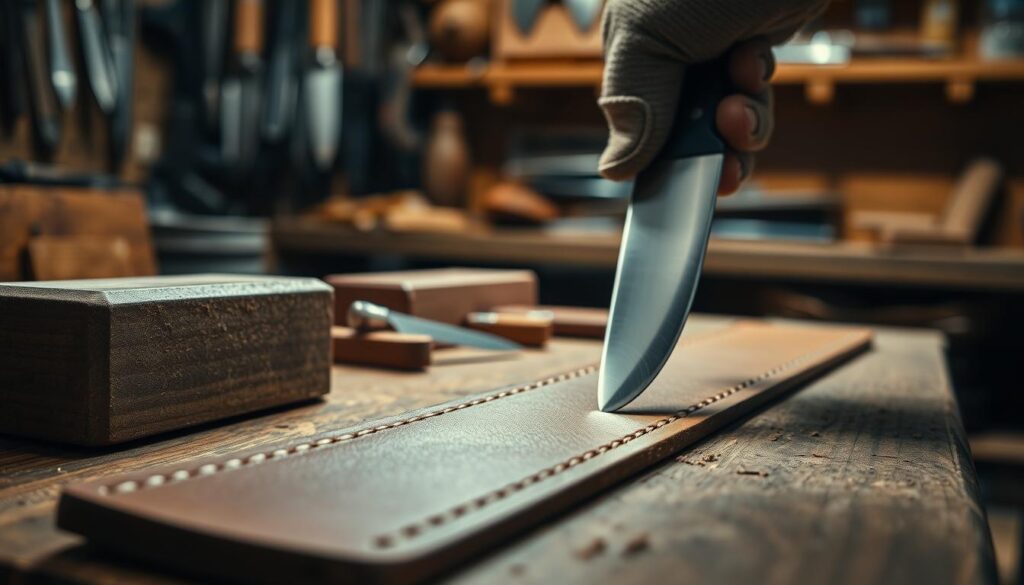
Apply a small amount of compound to quality leather—horse butt if you have it. Strop with the cutting edge trailing and use pull-only strokes to polish without rounding.
Safety tip: use tiny amounts of chromium oxide and avoid skin contact; aluminum oxide is a safer alternative.
- Quick use-it-now tests: paper slice, optional hair shave, and clean end-grain cuts with steady shavings.
- Keep a consistent process and repeat the light strop after heavy work to maintain edges.
Conclusion
Wrap your work with a short routine you can trust: set up flat, lock your angle, use steady push-pull strokes, confirm a full burr, move through grits, and finish with a polish. This simple step-by-step guide keeps edges ready in your shop so you spend more time woodworking.
Consistency beats perfection. Use the same process each session and you’ll save steel and effort over the long run. Keep marker checks, a full-edge burr before changing grits, and focused back work at the tip as your checkpoints.
Treat maintenance as a routine, not a repair event. Short, frequent stropping and light touch-ups extend the life of your tools and make the whole method feel natural. Different people follow different ways, but the payoff is the same: predictable, clean cutting performance that makes hand tool work smooth and controlled.