
7 Common Knife Sharpening Mistakes That Are Ruining Your Blades
You rely on a sharp tool in your kitchen, but when the edge dulls quickly you want answers. This intro explains why most problems are repeatable technique errors, not bad tools.
You’ll learn a clear framework to diagnose why a blade still feels dull after a session or why it chips fast. The key variables are angle, pressure, grit progression, and burr control.
Small faults add up. Over time they cause uneven bevels, extra steel removal, and edges that fail sooner than they should. That pattern is fixable once you spot the one variable that went wrong.
This section sets you up for the rest of the guide. You’ll get tool names and terms—whetstone, grit, burr, honing, stropping—so later steps make sense at a glance.
Why your knife still feels dull after sharpening
If the blade still feels dull after a session, the cause is usually a process error, not your tool.
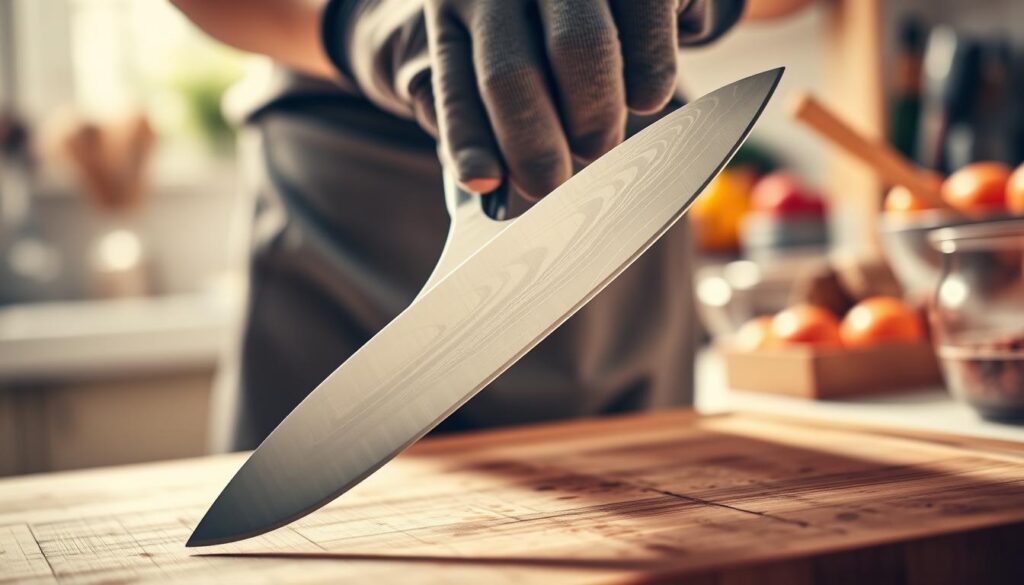
Sharpening is a system, not a single step
Angle, pressure, grit progression, burr formation, and consistency all must work together. One wrong variable and the whole sharpening process can fail.
What a sharp edge really is
A true sharp edge lives at the apex where both sides of the bevel meet. A polished bevel that never reaches that apex will look good but cut poorly.
How small errors shorten edge life
Missing a burr often means you never reached the apex. Incorrect angle or uneven pressure makes a thick, fragile edge that chips or folds on cutting tasks.
- Angle drift rounds the bevel and reduces bite.
- Too much pressure tears steel instead of refining it.
- Skipping grit steps leaves deep scratches under the edge.
Simple mental model: reach the apex, refine it, then deburr it. Follow that step each time and you fix common mistakes quickly.
Knife sharpening mistakes you’re probably making with angle and pressure
Most edge problems come down to two basics: the angle you set and how hard you press.
Choose a target angle that matches your steel and style. Aim ~12–15 degrees per side for many Japanese blades and ~18–22 degrees for many Western ones. Too steep makes a blunt, thick edge; too shallow makes a fragile one that chips.
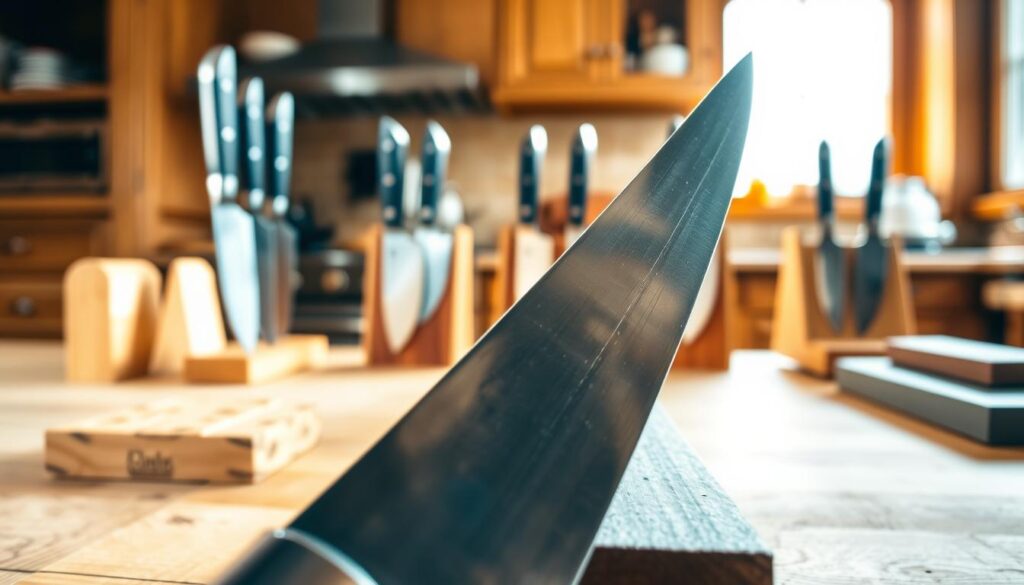
Lock a consistent angle and stop drifting
Angle drift happens when you change wrist position mid-stroke. Lock your wrist and move from your shoulders or hips so each stroke keeps the same bevel. Use the coin method or an angle guide to repeat the same degrees per side.
Pressure progression that actually works
Start with moderate pressure on coarse grit to shape the bevel. Move to lighter pressure on finer grits to refine the edge. Finish with feather-light strokes to clean the apex.
- Check mid-session: verify angle, verify pressure, then verify full-length strokes before switching sides.
- Too much force tears steel and leaves uneven bevels; too little too soon wastes time and prevents a burr.
Whetstone setup errors that sabotage the sharpening process
Before you touch the blade, your stone setup decides whether the session helps or harms the edge.
Match lubrication to the stone. Many water stones need soaking — commonly about 10–15 minutes until bubbles stop. Finer water stones may need less time. Oil stones require the correct lubricant. Proper lubrication lowers friction and makes each stroke more consistent.
Pick the right grit and protect steel
Start with a coarser grit for chips or heavy dulling. Use medium grits for routine work and fine grits to polish and refine the apex.
Starting too coarse for a light touch-up removes excess steel. Starting too fine wastes time when the edge needs real reworking.
Use the full stone surface
Move across the whole stone during strokes to avoid dishing. Even wear keeps contact predictable and helps you hold a steady angle.
Water stone vs. oil stone basics
Water stones feel faster and are popular in U.S. kitchens for speed and feedback. Oil stones run cooler and need oil but last longer without breaking down. Pick the type that matches your routine and maintenance habits.
- Pre-sharpen checklist: confirm stone type, confirm soak or lube, confirm starting grit, and stabilize the stone on a non-slip mat or towel.
- Keep the stone steady so your strokes stay controlled and repeatable.
Grit progression and burr control mistakes that keep edges from getting sharp
Grit sequence and burr control are the quiet causes behind edges that never hold. Follow a clear path from coarse to fine so each grit removes the scratches left by the last.
Why you can’t “polish” a dull blade with fine grits
If the edge is worn, skipping a coarser grit wastes time. Fine stones only hide deep scratches; they do not reshape the edge to the apex.
What deep scratches and big burrs do
Jumping from coarse to fine leaves subsurface gouges. Those scratches weaken the apex and make the sharp edge fade fast.
Use the burr as your guide
A small, consistent burr along the full length means you reached the apex on one side. No burr means you haven’t.
- Work coarse → medium → fine so each grit removes the prior grit’s marks.
- Rise a thin burr, then switch sides only after it runs heel-to-tip.
- Remove the burr with lighter finishing strokes, higher grits, and careful stropping for a durable sharp edge.
Bad sharpening habits that ruin consistency and shorten blade life
Small habits add up; a single rushed session can undo hours of careful edge work. Fixing them saves you time and preserves the blade.
Rushing and angle drift
When you hurry, your angle wanders. That rounds the bevel and makes cuts inconsistent even with the right grit sequence.
Over-working instead of honing
Don’t remove steel if you only need alignment. Use a honing rod for a rolled edge before escalating to a full sharpening.
Controlled strokes, not erratic motion
Repeatable strokes keep pressure steady from heel to tip. Erratic motions create uneven bevels and shorten edge life.
Stone care matters
A dished whetstone delivers bad contact and can convex the bevel. Flatten regularly, rinse slurry, and store stones dry to keep the surface true.
- Quick checks: test for a burr and for a rolled edge before removing steel.
- Adopt a minimum effective approach: do the least aggressive step that restores performance.
- Connect chips and rapid dulling back to habits like too much pressure, angle drift, or skipped maintenance.
Conclusion
A steady routine, not frantic effort, is what keeps edges reliable.
Core system: pick an angle you can hold, use the right grit progression, control pressure, raise and remove a controlled burr, and keep your stone flat. Follow that framework every session and your knives will cut consistently and last longer.
Before you stop, refine the edge with light stropping and use a honing rod between full sessions. This keeps you from removing excess steel and extends blade life.
If a related article won’t load and you see a “page blocked extension” or “extension blocked” notice, try disabling extensions temporarily, reload the page, then re-enable them one at a time to find the culprit.
Main takeaway: build repeatable technique, not brute force, and you get safer, cleaner cutting and longer-lasting edges.