
Finding the Perfect Sharpening Angle: German vs. Japanese Steel
You rely on your kitchen knives every day, so picking the right edge matters. This guide defines the term used here: the angle you hold the blade to the stone on each side, not the total inclusive angle.
Most Western or German-style knives start near 20° per side, while many Japanese blades are closer to 15–17° per side. Meat cleavers often sit around 25° per side. Those numbers are per side, so a listed 20° means 20° each side, not the combined figure.
Your goal is balance: get usable sharpness without sacrificing durability. I’ll show how steel hardness, edge geometry, and what you cut influence that trade-off.
By the end, you’ll have a short list of degree starting points and a simple way to match your existing bevel if you don’t know the factory setting. This advice targets US kitchens, where most knives are double-bevel and follow the per-side approach.
How sharpening angles work on kitchen knives
Understanding how you measure the edge on a kitchen blade clears up a lot of confusion. In simple terms, the edge angle is the per-side tilt you set when you work the cutting edge.
Edge angle vs. inclusive angle
Edge angle vs. inclusive angle
The number you hear—like “20 degrees”—usually means per side. That means a 20° on each side creates a 40° inclusive edge. This is why people can talk past one another unless they say “per side” or “inclusive.”
Secondary bevel vs. primary bevel
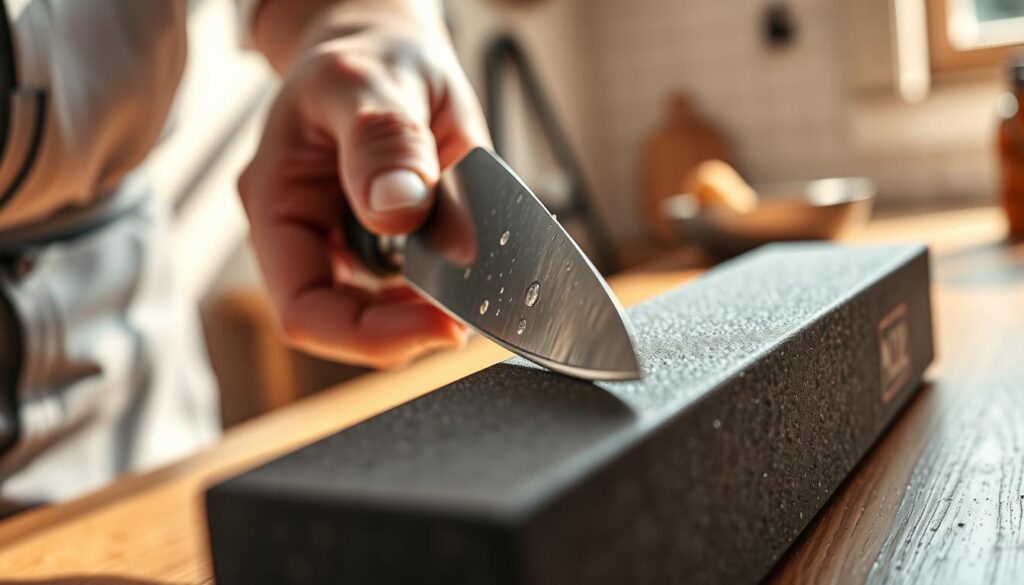
Most of what you remove while working an edge is the narrow secondary bevel. It is often only 1–2 mm at the very tip. The primary bevel is the larger grind that shapes the blade’s taper and usually stays untouched.
Double bevel vs. single bevel
Double-bevel knives get equal work on both sides. Single-bevel knives put the working edge on one side and a flat or hollow face on the other. In the United States, most kitchen knives sold are double bevel, even many japanese knives marketed here.
- Look: the secondary bevel is a thin band near the edge under bright light.
- Fact: lower per-side angles feel sharper but chip easier; higher per-side angles are tougher for hard food.
German vs. Japanese steel: choosing an angle based on hardness, toughness, and use
Steel chemistry and edge geometry together decide whether a blade stays sharp or chips under use.
Hardness and toughness: what they mean for your edge
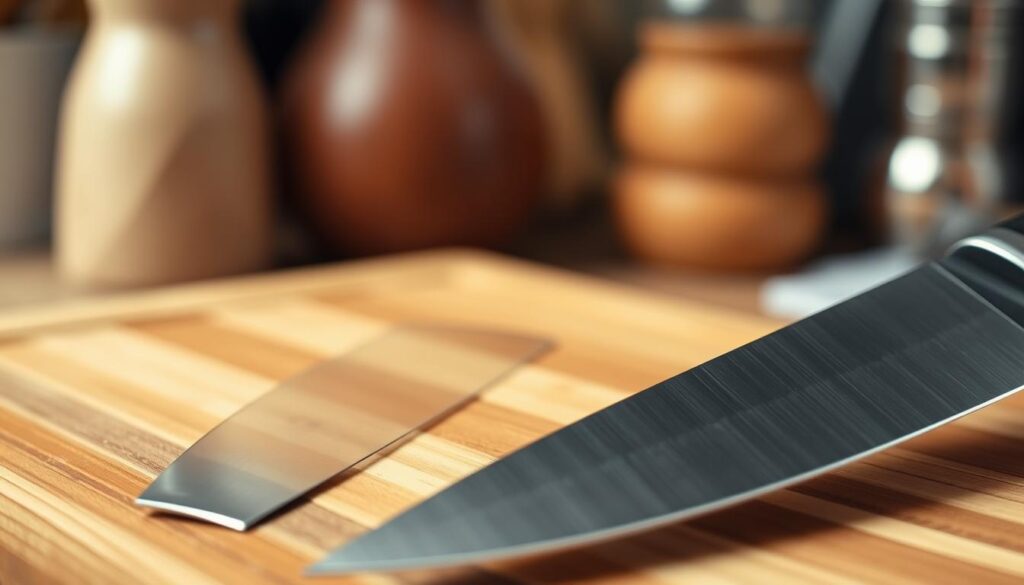
Hardness (measured on the Rockwell C scale) helps a blade hold a fine edge longer. Harder steels let you run a thinner edge with less rolling.
Toughness resists chipping and impact. As hardness climbs, toughness usually falls. Think of glass: very hard but brittle.
Typical differences between styles
Many Japanese steels run harder, so knives can perform well near ~15–17° per side without instant damage. Western and German steels often stay slightly softer and are set nearer 20° per side to improve durability.
Tradeoffs and practical rules
Lowering the angle gives better perceived sharpness and less cutting resistance, but it raises maintenance and chip risk. In a pro kitchen, frequent honing and periodic sharpening make lower angles practical if you commit to the process.
- If you see chips, raise the per-side angle a bit.
- If the knife drags on tomatoes, try a slightly lower angle if the steel supports it.
- Match your choice to task: slicing can be lower; chopping and heavy cutting should be higher.
Sharpening angles by degrees: practical ranges you can actually use
Pick an edge range you can live with: small changes in degrees change how a knife behaves. Below are clear degree brackets you can use as starting points, matched to common tasks and steel types.
Under 10° per side
These ultra-fine edges (straight razors are ~7–8° per side) give exceptional slicing but are very fragile. Avoid using them on cutting boards or twisting through bone; they fail quickly with rough use.
10–15° per side
This range suits fillet knives and many japanese knives. You get low resistance and clean slices, but you must avoid heavy chopping or cutting unknown materials.
15–17° per side
Many factory blades and newer Western designs sit here. You gain noticeable sharpness while staying realistic for careful kitchen use and routine maintenance.
17–22° per side
This is the sweet spot for most kitchen knives. It balances sharpness and durability well. German-style knives commonly live near 20° per side, which handles everyday cutting and board contact.
22–30° and over 30° per side
22–30° favors pocket, hunting, and outdoor knives where impact resistance matters. Above 30° is for cleavers, axes, and machetes where edge stability outweighs slicing performance.
- Range to reality: match the bracket to your blade’s steel and intended use, then test and adjust.
- Quick rule: lower degrees = finer cut, higher degrees = tougher edge.
How to find your knife’s current sharpening angle (without overthinking it)
Most factory edges are close but not exact, so a quick check saves you time and needless metal removal. Treat any published degree as an indication, not a hard rule.
Why factory settings vary
Even with CNC blanks, final finishing is often done by hand on belts. That means a listed 20° per side can land near ~18–22° in reality. Some brands like WMF and Victorinox use laser-controlled systems to tighten variance, but differences still happen across production runs.
How pros measure edge geometry
Retailers and shops may use a laser goniometer to read the secondary bevel. That gives a measured value, yet it remains an indication because measurement method and where you read the bevel affect the result.
Use the marker trick to match the bevel
Color the secondary bevel with a permanent marker. Make a few light strokes on your stone or sharpener, then inspect where the ink is removed.
- If ink stays at the tip, you are holding the angle too high.
- If ink remains near the shoulder, you are too low.
- Adjust until ink lifts evenly across the bevel.
This quick process saves time and metal. Once matched, you can keep that edge or nudge the angle slightly for more durability or more sharpness, remembering large jumps cost extra material and effort.
How to hold a consistent angle when you sharpen (stones, guides, and sharpeners)
Keeping a steady hand and a simple routine beats chasing exact degree numbers when you work an edge. Start by choosing one method—stone, guided system, or a bench sharpener—and stick with it until you learn the feel.
Whetstone basics
Use a visual cue (stack a few coins behind the heel) or the spine-to-thumb angle to set your first angle. Lock your wrists, apply even pressure, and make the same number of strokes per side.
Check for a burr along the opposite side to know you reached the apex. Once the burr forms, reduce pressure and refine until it disappears.
Guided systems and angle changes
Guides help, but note that a set degree can shift with blade height or clamp position. Always verify contact with the marker trick rather than trusting the printed scale.
Small guides, finishing, and abrasives
Inexpensive angle guides build muscle memory. For 6000+ grit stones or a leather strop, lift the angle 1–2 degrees so the very apex gets refined instead of rounded.
Water stones suit harder steels and delicate edges. Use coarse for repairs, medium for shaping, and fine for polishing.
- Consistency first: steady strokes and repeatable setup matter more than chasing an exact number.
- Verify: marker trick and burr checks save metal and time.
- Troubleshoot: if a demo video won’t load and you see “page blocked,” try disabling browser extensions, reload the page, then re-enable extensions after.
Repeatable system: pick one method, confirm the bevel, keep your angle stable, and you’ll improve faster than switching tools each session.
Conclusion
Small, sensible changes to your edge produce big benefits in real cooking situations.
Choose a starting point: about 15–17° per side for many Japanese knives, ~20° per side for Western/German kitchen knives, and near 25° per side for cleavers. Treat factory settings as variable and use the marker trick to match the bevel before you work the metal.
Remember you are usually caring for a thin secondary bevel. A few degrees shifts the feel and the blade’s durability more than you might expect.
If you chip, raise the angle a bit; if the edge rolls or drags, lower it slightly within what the steel and use allow. Keep a steady maintenance rhythm—short, regular sessions and honing beat one big regrind.
Practical next step: pick one knife, match the bevel, record the setting, and repeat that way for faster, more reliable results in your kitchen.