
Left-Handed Knife Sharpening: Adjusting Angles for Southpaws
You’ve probably noticed that many knives feel different when you hold them in your left hand. The blade may seem sharp, yet it steers off line. Edge geometry and handle shape can bias the cut toward the right hand and make simple tasks feel harder.
This section shows what practical sharpening for left-handers means: choosing a 50/50 or mildly asymmetric edge, keeping repeatable angles, and finishing to reduce burrs. Small angle changes can improve control without removing lots of metal.
You’ll learn how to spot the blade’s left or right bias, decode common grind ratios (50/50 to 90/10), and adjust the edge for predictable tracking. Most home cooks don’t need extreme asymmetry to slice onions cleanly, but a small tweak can stop the “fighting the knife” feeling and make your prep safer and more consistent.
Why Knife Edges Feel Different in Your Left Hand
Edge geometry is the hidden force that changes how a knife moves through food. When one side of the bevel is wider, the blade can pull your cut off line. That pull is most noticeable in dense produce like carrots or onions.
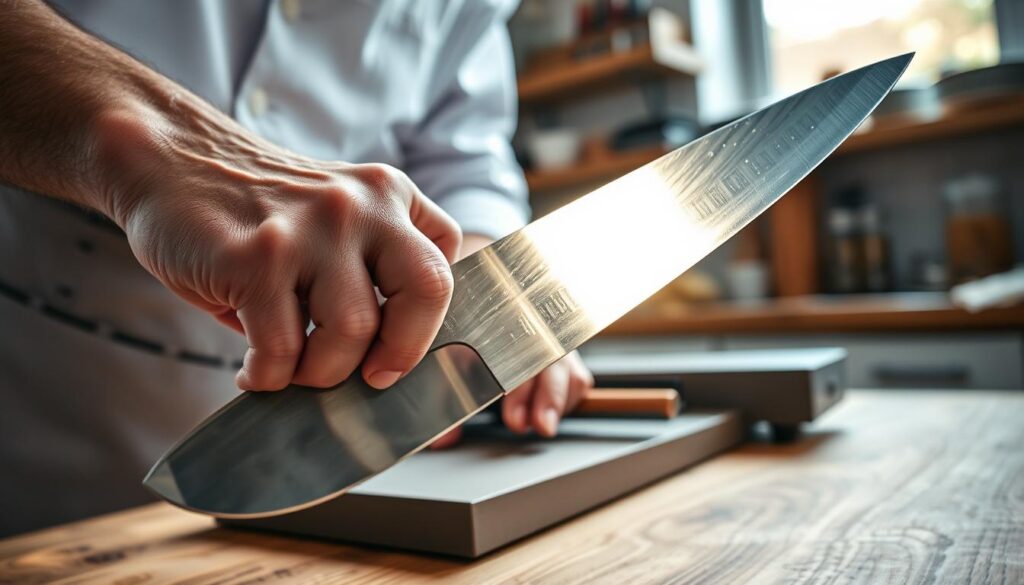
How an asymmetric edge can “steer” your cuts
Think of a V-shaped cross section with one side wider. The wider side pushes more material aside and creates a torque. For a right handed grip that torque can help steer straight.
In the wrong hand, that same bias can make the blade walk away from the wide side. You may feel curved slices, extra pressure to keep a line, or the knife wanting to roll during delicate work.
Sharpness vs durability trade-offs when you change the bevel
A thinner edge behind the apex often feels sharper. That bite improves slicing, but it also reduces resistance to impact burring.
- Thin bevel = more perceived sharpness, less edge life.
- Wider bevel = more durability, less initial bite.
- Most home cooks benefit from a balanced approach that tunes side bias without sacrificing stability.
Know Your Knife Geometry Before You Sharpen
Start by placing the handle toward you and the cutting edge down; this simple stance fixes left and right sides so you always orient the blade the same way.
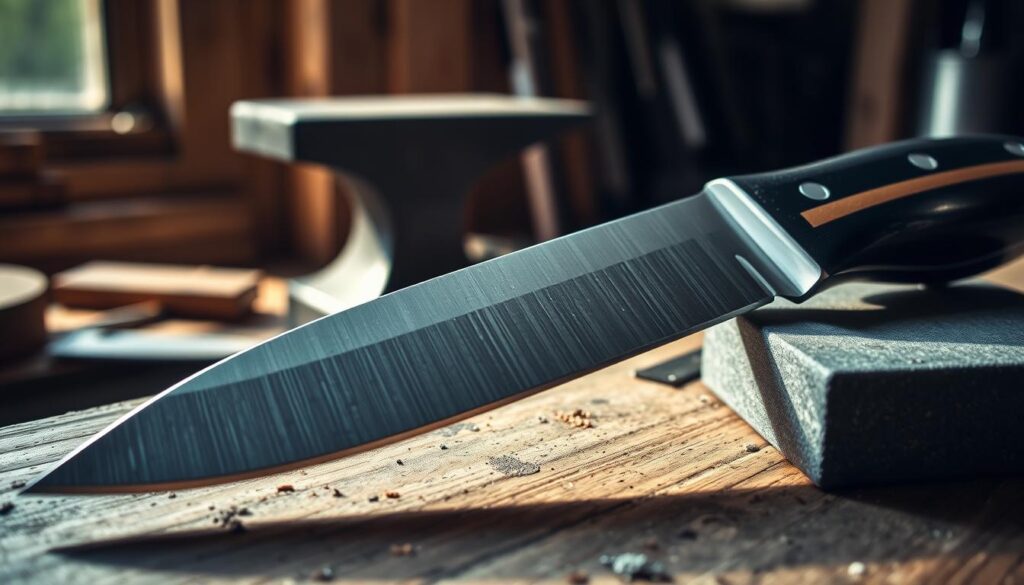
How to tell which face is more ground
With the handle toward you and the edge down, the right side blade sits on your right and the left side blade sits on your left. Look along the flats to spot a wider bevel band or a sharper shoulder.
A side blade that looks flatter or chisel-like is usually the more ground face. That face will steer cuts toward the opposite hand.
Double bevel vs single bevel
Double bevel means two mirrored bevels meet at the apex. A single bevel has one main bevel and a mostly flat back with a small relief area.
Common grinds and the eyeball reality
- 50/50 grind — appears symmetrical.
- 60/40 and 70/30 — mild-to-moderate bias you can often spot by eye.
- 90/10 — strong bias that will likely steer in the wrong hand.
Published ratios are approximations. Without measuring tools you’ll be estimating grind widths, and many pros treat 60/40 and 70/30 as roughly the same. Before you work the edge, confirm which side blade is dominant so you don’t increase an existing bias.
Sharpening for left-handers: Choose the Right Edge Strategy
Picking the right edge plan can save a lot of frustration at the prep station. First, decide if you want a neutral, repeatable edge or a small bias tuned to your dominant hand.
When sticking with a 50/50 edge makes the most sense
If knives are shared, or you inherit a blade with unknown factory geometry, a true 50/50 grind is the safest choice.
50/50 gives predictable performance to anyone who picks up the knife and removes most surprises in tracking.
When a mild lefty asymmetry (about 2:1) improves control
If a knife consistently tracks off-line when you slice, a mild left-handed bias around 2:1 often corrects that without weakening the edge.
Keep the main bevel angles close and only shift small amounts; this keeps durability high while letting the blade track straighter under your cuts.
If you share knives with right-handed users: picking a practical compromise
In mixed-handed kitchens, keep most knives 50/50 and reserve one or two personal knives with a subtle left bias for precision work.
When you buy knives online or can’t inspect them, plan to test-cut and then adjust the edge. The edge matters more than perfect ratios; repeatable technique beats chasing exact numbers.
- 50/50 for shared use and unknown factory grinds.
- ~2:1 left bias if the blade fights you during fine slicing.
- Keep a personal left-biased knife if you do a lot of precision prep.
Step-by-Step: Sharpen a Knife as a Lefty Without Fighting the Blade
Start with a simple setup so your angle stays steady and repeatable. Use a stable stone base or a reliable sharpener on a flat surface. Good light and a comfortable stance let your left hand control pressure without wobble.
Set up your stones so the angle stays consistent
Mark a target angle and keep your wrist and elbow still. A guide or visual cue on the bench helps you hit the same angle every pass.
Use the burr method to build a left-friendly bevel over time
Work the outside (left side when you hold the handle toward you, edge down) until you feel a continuous burr along the full edge. Then switch sides and remove the burr with lighter strokes.
Where to start and how to avoid excess metal removal
- Start on the left side to nudge a mild left bias, but don’t overdo it — small shifts add up across sessions.
- If the blade is strongly right-biased, first reprofile toward a 50/50 ground before adding asymmetry.
- Spend a bit more time on one side during corrections, but keep strokes measured to preserve metal.
Finishing passes for better cutting feel on food
Finish with alternating light passes and a few edge-leading strokes to reduce wire edges. Low pressure and short strokes remove burr remnants and improve sharpness and tracking during cutting.
- Stable setup → repeatable angle.
- Raise burr on outside face, then refine opposite side.
- Neutralize extreme bias first, then develop gentle left bias over time.
Adjusting Angles and Asymmetry Without Overcomplicating It
Consistent angles beat clever tricks when you want a reliable kitchen edge. Pros disagree on whether to change the per-side angle or just vary time and pressure to create asymmetry.
One camp sets different angles per side to match a planned asymmetry. Another camp keeps the same angle on both sides and simply spends more strokes on the desired side. Both approaches work if you repeat them every session.
Simple baseline for double-bevel knives
Pick one per-side angle you can hold consistently. Use that angle on both sides, then add a few extra passes on the side you want biased.
- Choose an angle you can reproduce easily.
- Adjust asymmetry by stroke count, not by chasing tiny angle differences.
- Keep notes so you repeat the same way next time.
Match asymmetry to steel and use case
Harder steel tolerates thinner, more asymmetric edges with less risk. Softer or tougher steels may roll or form bending burrs under heavy impact.
Impact burring happens when you hit boards, bones, pits, or hard rinds. High asymmetry raises the chance of these bending burrs and reduces long-term durability.
If/then shortcuts to save time
- If you see chipping or frequent burrs, reduce asymmetry and raise the angle slightly.
- If the blade feels stable but still steers, try a mild bias by adding a few light passes on your preferred side.
- Remember: the best way is the one you can repeat reliably.
Japanese Knives, Single Bevel Blades, and Left-Handed Realities
Not every Japanese knife is a single-bevel specialty. In fact, most japanese knives you see—gyuto, santoku, nakiri, and petty—are double-bevel and work well in either hand.
Why single-bevel blades annoy in the wrong hand
Single bevel shapes like usuba, yanagiba, and deba are ground to favor one face. That built-in bias makes the blade track toward the right side or left side blade, so slicing can pull off-line in the wrong hand.
Availability and buying tips
Lefty single bevels exist, but they are rarer and often cost about 20–30% more due to low volume production. If you plan to buy a single bevel, confirm whether the knife is made with the correct right side or left side geometry before you buy.
- Neutral picks: gyuto, santoku, nakiri, petty are usually lefty-friendly.
- Handle fit: most handles are symmetrical, but D-shaped handles (e.g., Shun Classic) feel odd in the left hand.
- Workaround: a mostly 50/50 bread knife like the Ryusen Prever can feel neutral for daily use.
Conclusion
Even a well-honed blade may steer away from your line when the bevel favors the other side.
Your main takeaway: a knife can be sharp and still feel wrong if the grind and edge bias don’t match how you cut. Keep shared knives at a true 50/50 grind, or develop a mild left asymmetry over time if the blade keeps pulling.
To tell the difference, place the handle toward you with the edge down. Look for the wider bevel on the side that will make the blade track off line.
Use a steady angle, the burr method, and start by raising the first burr on the outside (left) face. Finish with light alternating passes to clean the edge.
When buying, check how the knife is ground or how it was knife sharpened. Repeatable technique and a stable, predictable edge make the biggest difference day to day.