
How to Choose the Right Polishing Compound for Your Leather Strop
You want a clean, sharp edge that feels finished. Stropping is the final step that polishes and aligns an edge. A leather strop can remove micro-burrs and improve cutting performance when used correctly.
Start by defining the problem: does the blade feel almost sharp or overly harsh in use? That tells you whether leather-only finishing will work or if you need an abrasive layer.
Think of your setup as a system: strop material, abrasive type, grit, and technique. A mismatch in any part causes poor results, not a bad product.
This guide will compare chromium oxide, aluminum oxide, and diamond options. It will also cover formats like bars, paste, sprays, and emulsions so you can buy with confidence.
You’ll learn decision points: what you sharpen, the finish you want, your steel type, and how fast you want the cut. Practical application and reset steps are included to keep your leather strop consistent and free of cross-contamination.
Why stropping is the finishing step that makes an edge feel “done”
Think of stropping as the last touch that turns a workable blade into one that feels complete. A quality leather surface aligns the very apex and removes tiny micro-burrs left by sharpening. That cleanup makes the blade glide instead of catch.
Micro-burrs form when metal folds or tears during sharpening. A few gentle passes on leather repositions the metal so the edge tests sharp and feels refined in use.
Consistent stropping also stretches the time between full sharpening sessions. By maintaining the apex you stop the edge from degrading into truly dull territory.
- Kitchen knives: quick daily maintenance keeps slicing clean.
- Hunting blades: short pre-use touchups preserve control.
- Woodworking tools: finish passes refine cut quality.
For straight razors, a razor strop routine is as much about comfort as raw keenness. Regular attention makes stropping a normal part of tool care, not a rare overhaul.
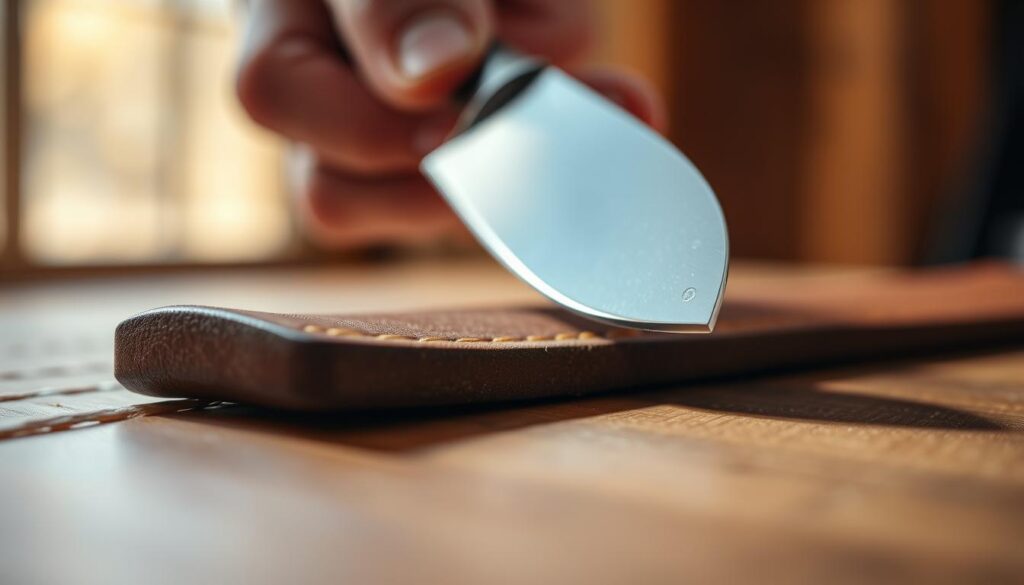
Decide what you’re sharpening and what “sharp enough” means to you
First, match the blade’s purpose to the finish you want—comfort, control, or durability. Your chosen finish drives how much time you spend on a leather finish and which products you select. Pick a target before you start.
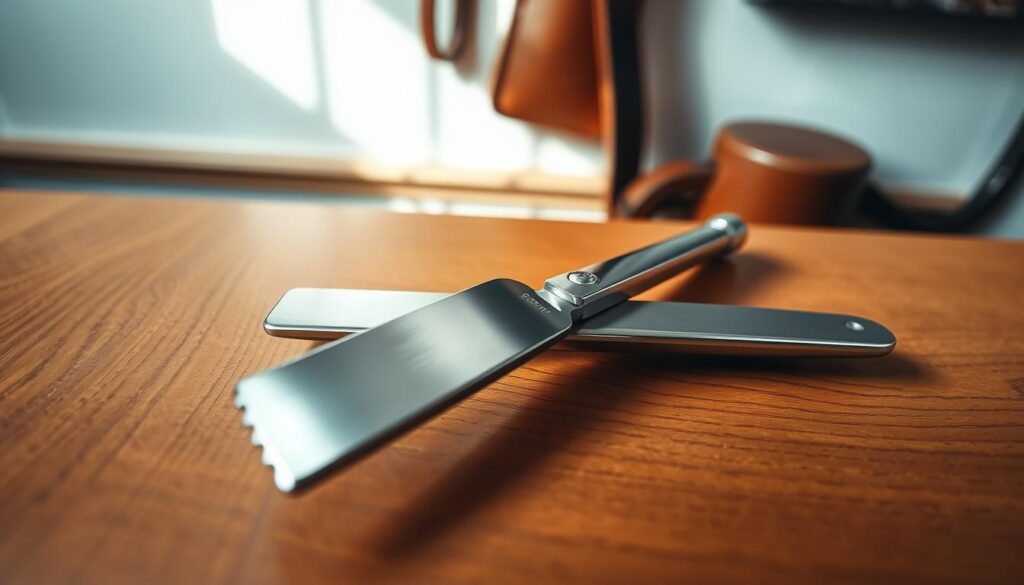
Smooth comfort for straight razors
Straight razors need a refined surface to reduce drag on skin. Consistent passes yield comfort more reliably than aggressive polishing. Aim for a predictable, smooth feel that cuts without tugging.
Clean slicing for kitchen and hunting knives
For kitchen knives, sharp enough means clean slices and steady control. For hunting knives prioritize bite and durability when cutting fibrous material. Choose a progression that balances daily prep needs with field robustness.
Crisp results for woodworking tools
Woodworking tools demand a stable, well-refined edge for crisp paring and smooth end grain. Match your finishing steps to the work; this keeps planing and carving predictable.
- Start with the end use: shave, food prep, field work, or fine woodworking.
- Choose a progression that fits the steel and the angle; avoid over-polishing.
- Remember to use strop once you reach your target finish.
Strop paste and compounds: what you’re actually buying
Adding abrasive products turns a plain leather surface into an active polishing tool. That changes stropping from simple alignment into a controlled finishing step that can raise sharpness and mirror shine.
Leather-only finishing versus abrasive-loaded leather
Leather-only finishing is gentle. It mostly realigns the very edge without removing measurable metal.
When you add abrasives, the surface removes tiny imperfections. This is material removal at ultra-fine scale, not just smoothing.
How micro-abrasives work
Think of polishing as ultra-fine sanding. Tiny particles lap away burrs and peaks until the apex becomes consistent.
A stropping compound often comes as a block you rub onto leather. The result behaves like very fine sandpaper at micron levels.
- What compound-loaded stropping means: you add abrasive to leather so it does more than align the edge.
- Format differences: strop paste, bars, sprays deliver grit differently; particle size matters most, not packaging.
- Set expectations: good technique beats expensive products; consistency matters for lasting results.
Understand “bite” vs “polishing” before you choose a compound
Understanding how aggressively an abrasive cuts will steer your choice. Bite describes how fast a product removes metal. High bite fixes a poor edge quickly. Low bite mainly smooths the apex without much metal loss.
When you want faster material removal
Pick more bite if a stone left heavy burrs or the bevel needs reshaping. A stronger abrasive shortens correction time. This is the practical way to recover a rough edge before refinement.
When you want maximum shine and refinement
Polishing effect is how smooth the edge becomes. A fine product reduces harshness, improves feel, and makes slicing predictable. Smaller particles, lower bite, better finish.
Why pairing a faster option with a finer compound often works best
- Use a higher-bite product first to correct geometry.
- Follow with a finer compound to refine the apex.
- Diamond sprays or diamond paste often balance bite with polish for faster results on hard steels.
Grit, micron, and finish goals: how fine should your stropping compound be?
Micron ratings tell a clearer story than color or marketing when you shop for diamond products. Many makers label by micron, which directly shows particle size and the expected finish.
Common checkpoints you will actually see are 4, 2, 1, 0.5, 0.25, and 0.10 micron. In practice, 4–2 micron removes visible scratch patterns quickly. One micron moves toward a refined face. Sub‑micron sizes like 0.25 and 0.10 produce very high levels of finish.
Think of stepping down as a two- or three-stage plan. Start coarser to fix geometry, then move to finer grain to erase the previous pattern and refine the apex.
- Translate grit vs micron: grit numbers map to micron size—micron is the direct measure.
- Buy to avoid contamination: begin with the finest diamond grain available for a given leather surface to prevent coarse particles from ruining a final finish.
- Match finish to use: mirror polishing looks impressive but may reduce bite for tasks that need more bite at the edge.
Choose micron sizes that fit your steel and use case. You don’t need the finest option for every knife; pick what gives the right balance of bite and polishing for your work.
Don’t rely on color alone when shopping stropping compounds
Color is an unreliable shorthand when you shop for finishing products. Manufacturers tint their mixes differently, so green or white does not guarantee a specific abrasive type or fineness.
Why black, green, and white vary by maker
Black can be coarse or very fine. Labels and marketing often hide the real particle size. Look past the hue to the specs.
What to check before you buy
- Confirm abrasive type: chromium oxide, aluminum oxide, or diamond.
- Check stated micron or grit and listed grain size.
- Verify intended use and the substrate (leather, balsa, felt).
- Read reviews from users with steels like yours for real-world feedback.
Watch for application signs: if you see leather through a patchy layer or the compound loads unevenly it causes inconsistent results. Compare both particle size and formulation because binders and concentration change how aggressively a product cuts. Prioritize clear micron/grit labeling and trustworthy descriptions over color tradition to get repeatable performance with your tools.
Compound formats compared: bars, pastes, sprays, and emulsions
Choose a format that fits your routine—each delivery method behaves differently on leather. Your workflow and tolerance for mess decide whether you reach for a hard bar, a spreadable option, a spray, or a diamond paste.
Stropping compound bars and blocks
Bars feel like a crayon on leather. They are durable and last long, but rushed application can leave streaks.
Use steady pressure and full coverage for a smooth, even surface.
Stropping paste for quick, even coverage
Strop paste spreads easily without heat. It gives beginners consistent lubrication and fewer variables during use.
Diamond spray for speed with a strong bite
Diamond sprays are fast and aggressive. Apply sparingly so you don’t make the edge harsher than needed.
Diamond paste for controlled dosing and consistent results
Dot small amounts of diamond paste, then massage it into the leather. This method saves material and keeps concentration steady.
- Bars: long-lived but need careful rubbing for even coverage.
- Pastes: fast, smooth spread—good for quick reloads.
- Sprays: instant bite—use light dosing for touchups.
- Diamond paste: repeatable control for bench work.
Chromium oxide and green compound: where it fits in your progression
A light layer of chromium oxide often serves as the finishing-oriented abrasive that gives a refined, comfortable edge. Use this when you want polish without heavy metal removal. It sits after coarser work and before any mirror-level steps.
When green stropping is a smart final polish choice
Choose green stropping after stones or a stronger abrasive have fixed geometry. It tidies the apex, reduces drag, and makes slices more predictable. For kitchen knives and razors, this is a classic final pass.
What to watch for when comparing different green options
Compare by stated abrasive and particle size, not color. Binder type and loading density change feel: waxy mixes may clump, while thin loading can leave ridges. Look for clear micron info.
- Signals it’s working: smoother paper cuts, steadier glide in use, a uniform bevel.
- Product check: confirm chromium listings and particle sizing before you buy.
- Choice tip: chromium gives polish with less bite than many diamond alternatives.
Aluminum oxide and white compound: when it’s the better pick
If you want a clean, predictable finish without removing much metal, aluminum oxide is a smart choice. At a high level, aluminum oxide is a hard, durable abrasive that gives a steady, fine polish to steel. It removes tiny burrs while keeping geometry intact.
White compound versions are tuned for refinement. Use them when you need smooth slicing and consistent feel rather than aggressive reshaping.
- Real tasks: kitchen knives that must slice cleanly, and woodworking tools that need crisp, controlled cuts.
- Workflow fit: follow a slightly faster abrasive with aluminum oxide to erase scratch patterns and improve consistency.
- Buying tip: choose products with clear grit or micron specs and confirm they are formulated for leather finishing, not just buffing wheels.
Remember: the best choice depends on what you cut and the feel you want. Aluminum oxide often balances bite and polish, making it a reliable middle ground for many users.
Diamond compounds: when you want fast cutting and a polished edge
When speed matters, diamond offers the abrasive power to shorten finishing time without sacrificing shine. You get rapid material removal that still produces a refined apex when used carefully.
Polycrystalline emulsions vs diamond paste
Emulsions spread thin and even across leather. They give broad coverage with a light, consistent bite.
Diamond paste lets you dose precisely and load a thicker, richer layer where you need it. Use paste for controlled bench work and emulsions for quick reloads.
Example micron ranges you’ll see
- Common listings: 4, 2, 1, 0.5, 0.25, 0.10 micron.
- Paired packs: 5/3.5 micron and 1/0.5 micron options.
When diamond makes sense
Pick diamond if your steel is stubborn or you want faster results after stones. Match your starting point to the last sharpening step: choose coarser micron for scratch refinement, finer for apex improvement.
Tip: diamond cuts fast. Use a light touch and conservative loading to avoid overdoing bite or rounding the edge.
Build a practical compound progression for your strops
Design a practical sequence so each leather surface has a clear job and predictable results. Start by matching the steps to the steels you own, how often you sharpen, and how much time you can spend on maintenance.
Two-strop setups that balance bite and polish
Keep it simple: a mid-range diamond step for bite, followed by a finer finishing step for feel. This gives fast correction with a pleasant final cut.
Three-strop setups for more control and a finer finish
Use three dedicated surfaces so each one handles a single role: correction, refinement, and final feel. That separation prevents contamination and makes results repeatable.
How to avoid going finer than your current edge can support
If the bevel still shows coarse scratches, a finer compound will not help. Step back to a coarser stage or repeat sharpening until the scratch pattern matches the desired finish.
- Keep each leather strops dedicated to one abrasive to reduce cross-contamination.
- If a finer compound does not improve performance, improve the earlier sharpening step instead.
- Choose a progression that fits your routine for predictable, repeatable edges.
How to apply stropping compound to a leather strop the right way
Good application starts with an even, repeatable technique. Treat the block like a crayon: press firmly and draw consistent strokes along the working face. Move the bar across the leather so coverage builds from one edge to the other.
Crayon-style application for bars and blocks
Use steady pressure and overlapping passes. Keep strokes short and even to avoid ridges.
Check the surface often. Stop when the leather looks uniformly coated and you can no longer see the fiber through the layer.
Heat-assisted application for harder compounds
Harder material can chunk unless warmed. Hold the block about 20 cm above a low heat source and warm until it’s barely comfortable to hold.
Apply while slightly softened so the abrasive bonds and spreads without large clumps.
Finishing the surface for smooth tracking
After laying material, rub the area with kitchen paper to reduce highs and lows. This evens the coating so the blade tracks smoothly.
Fixing crumbly mix and re-smoothing
If the layer flakes, reheat briefly and re-spread rather than scraping off entirely. That restores adhesion and keeps your strops made ready for consistent use.
- Tip: full, even loading prevents patchy cutting action—cover the leather entirely when appropriate.
How to apply stropping paste, diamond spray, and diamond paste
Apply each product with control so your edge reacts predictably. Use measured amounts and keep coverage even across the working face to avoid hot spots.
Paste application for fast, even lubrication
Use stropping paste as the quickest, least fussy option. Place a small amount, spread it across the surface, then smooth with kitchen paper for uniform coverage.
Diamond spray dosing and why more can be too aggressive
One light pass is often enough. About two sprays covers an entire working face. Excess makes the edge harsher and wastes material. Keep sprays away from eyes; wash hands after handling.
Diamond paste dots and the massage-in method
Dot the leather with tiny amounts across the face. Work each dot in until it blends; less than you expect is usually right. This gives even bite across your tool contact area and avoids sudden changes in feel.
Re-soften a dry diamond-paste surface
If the layer feels rough, use a light mist of medicinal alcohol from an atomizer. That re-softens the layer without flooding the leather and restores consistent tracking.
- Quick tips: small doses, even spread, and conservative use keep results repeatable.
How to remove compound and reset your strop surface
You don’t always need a new leather face to try a different finish. If the working surface has a messy layer or you want better loading for a new compound, a reset is the smarter way to proceed.
When reuse makes sense
Reuse the strop if the leather is intact, not deeply gouged, and only the coating needs removal. It’s ideal when you tested a different compound or made a heavy, uneven application.
How to reset the face
Use ~240‑grit sandpaper and work in small circular motions across the area. Light pressure removes the layer while roughening the surface evenly for future loading. Check often; stop when the face looks uniform.
Cleaning to avoid contamination
After abrasion vacuum or wipe the leather to pull out trapped particles. Leftover abrasive will contaminate a finer compound and ruin results.
- Even resurfacing prevents hot spots that change how an edge tracks.
- Replace the strop if the leather is compressed, torn, or too contaminated for practical cleaning.
- Resetting correctly saves money and lets you experiment without buying several strops.
What to buy: starter picks and bundles that simplify the decision
Start by deciding whether you need a blank leather face or a ready-loaded kit for faster results. Your choice depends on how finished your bevels already are and how much time you want to spend tuning a setup.
When a blank leather strop is enough to start
If your edges are already solid off the stones, a Blank Leather Strops Pack ($36) is a great start. It gives you a smooth surface to align the apex and extend time between sharpenings.
When a leather strop plus diamond emulsion pack is the best value
Choose a loaded kit if you want faster improvement and easier repeatability. Examples: 4/2 Micron Diamond Emulsion and Leather Strops Pack ($86) or 1/0.5 Micron Diamond Emulsion and Leather Strops Pack ($86). These combo packs save time and match abrasive to leather.
How to choose micron pairings
Pick 4/2 for repair and bite, 1/0.5 for refinement, and 5/3.5 when you need a more aggressive first working face.
When to consider specialty leathers like kangaroo
Kangaroo leathers are firmer and more consistent. Opt for the Blank Kangaroo Leather Strops Pack ($55) or the Kangaroo bundle with 0.25 and 0.10 micron emulsions ($105) when you tune razor strops or fine tools.
- Pair wisely: buy one blank and one loaded setup to cover most knife, razor strop, and woodworking needs.
- Best practice: keep each leather dedicated to a single abrasive to avoid contamination.
Conclusion
Conclude by aligning your target finish with a grit and abrasive that suit your steel and tasks.
Pick the finish based on what you cut, then choose an abrasive family and micron range that matches your last sharpening step and your tolerance for bite.
Remember: consistent stropping with a clean, evenly loaded leather face—not guesswork about color—makes the edge feel finished. Apply bars, spray, or small dots carefully and reset the surface periodically to avoid contamination.
Chromium and aluminum oxide options give reliable polish, while diamond delivers faster cutting when you need bite. Use a simple one- or two-surface system with dedicated abrasives for repeatable results.
If you’re unsure which progression fits your steels and tools, contact Sharpening Supplies at 1-800-351-8234 or [email protected] (Mon–Fri, 8 a.m.–4 p.m. CT).